

mTLS Explained
Comprehensive Guide to Mutual TLS (mTLS)
Section titled “Comprehensive Guide to Mutual TLS (mTLS)”Table of Contents
Section titled “Table of Contents”- Introduction
- What is TLS?
- What is Mutual TLS (mTLS)?
- How mTLS Works
- Components of mTLS
- The mTLS Handshake Process
- Benefits of mTLS
- Use Cases
- Implementation Considerations
- Common Challenges
- Best Practices
- Implementation Examples
- Conclusion
Introduction
Section titled “Introduction”Mutual TLS (mTLS) is a security protocol that provides mutual authentication between a client and a server. Unlike standard TLS, which only authenticates the server to the client, mTLS ensures both parties verify each other’s identity through X.509 digital certificates. This document provides a comprehensive overview of mTLS, its workings, benefits, implementation considerations, and best practices.
What is TLS?
Section titled “What is TLS?”Transport Layer Security (TLS) is a cryptographic protocol designed to provide secure communication over a computer network. Standard TLS provides:
- Authentication: Verifies the identity of the server
- Confidentiality: Encrypts data in transit
- Integrity: Ensures data hasn’t been tampered with
In standard TLS, only the server is authenticated to the client using a digital certificate, while the client typically remains unauthenticated or uses other methods like passwords.
What is Mutual TLS (mTLS)?
Section titled “What is Mutual TLS (mTLS)?”Mutual TLS extends standard TLS by adding client authentication. With mTLS:
- The server authenticates the client using the client’s digital certificate
- The client authenticates the server using the server’s digital certificate
This two-way authentication creates a stronger security model where both parties must provide cryptographic proof of their identity before establishing a secure connection.
How mTLS Works
Section titled “How mTLS Works”Mutual TLS works through the exchange and validation of X.509 digital certificates. The process includes:
- Certificate issuance and installation
- TLS handshake with certificate exchange
- Certificate validation
- Secure communication
Components of mTLS
Section titled “Components of mTLS”Digital Certificates
Section titled “Digital Certificates”X.509 certificates contain:
- Public key of the certificate owner
- Identity information (Common Name, Organization, etc.)
- Digital signature from the issuing Certificate Authority (CA)
- Validity period
- Certificate policies and extensions
Certificate Authority (CA)
Section titled “Certificate Authority (CA)”A Certificate Authority is a trusted entity that issues digital certificates. The CA:
- Verifies the identity of certificate requestors
- Issues signed certificates
- Maintains Certificate Revocation Lists (CRLs)
- Provides Online Certificate Status Protocol (OCSP) services
Public Key Infrastructure (PKI)
Section titled “Public Key Infrastructure (PKI)”PKI is the framework of policies, procedures, hardware, software, and people that manages digital certificates. It includes:
- Certificate Authorities (Root and Intermediate)
- Registration Authorities
- Certificate repositories
- Certificate management systems
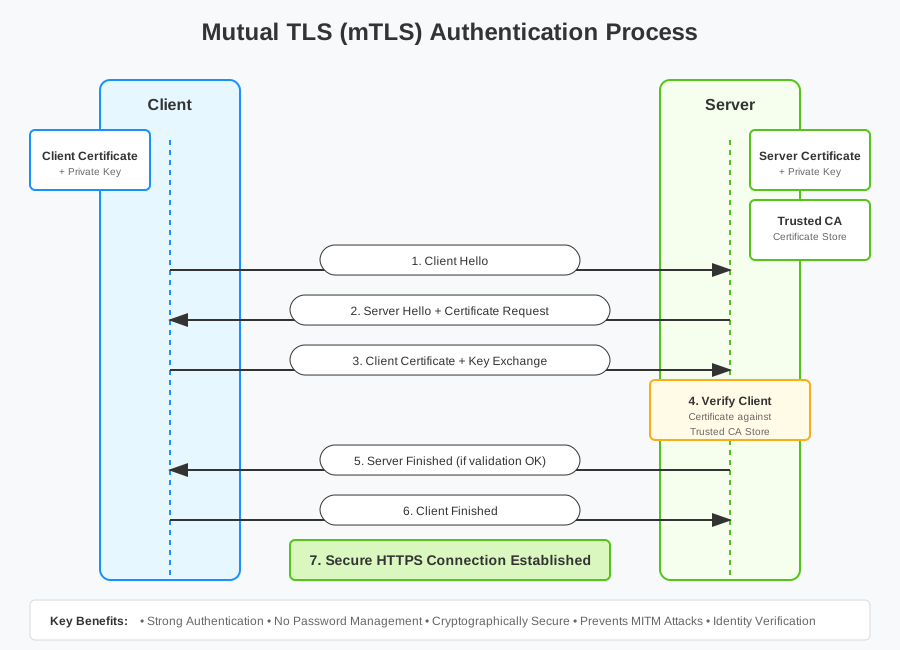
The mTLS Handshake Process
Section titled “The mTLS Handshake Process”The mTLS handshake follows these steps:
- Client Hello: Client initiates connection and sends supported TLS versions and cipher suites
- Server Hello + Certificate Request: Server responds with selected protocol version, cipher suite, its certificate, and requests a client certificate
- Client Certificate + Key Exchange: Client sends its certificate, verifies server’s certificate, and sends key exchange information
- Certificate Verification: Server verifies the client’s certificate against trusted CAs
- Server Finished: Server completes its part of the handshake
- Client Finished: Client completes its part of the handshake
- Secure Connection Established: Encrypted communication begins with both parties authenticated
Benefits of mTLS
Section titled “Benefits of mTLS”Enhanced Security
Section titled “Enhanced Security”- Strong Authentication: Cryptographic proof of identity for both client and server
- No Password Vulnerabilities: Eliminates risks associated with password-based authentication
- Phishing Protection: Difficult for attackers to steal certificate-based credentials
- Defense in Depth: Adds an additional security layer
Improved Trust
Section titled “Improved Trust”- Identity Assurance: High confidence in the identity of both parties
- Non-repudiation: Parties cannot deny their participation in the communication
- Chain of Trust: Leverages hierarchical trust model of PKI
Operational Advantages
Section titled “Operational Advantages”- Automation-Friendly: Certificates can be managed through automated systems
- Centralized Control: Easier revocation and management through the CA
- API Security: Ideal for securing machine-to-machine communications
Use Cases
Section titled “Use Cases”Microservices Architecture
Section titled “Microservices Architecture”In microservice environments, mTLS provides:
- Service-to-service authentication
- Encrypted communication between internal services
- Defense against lateral movement within a network
Zero Trust Security Models
Section titled “Zero Trust Security Models”mTLS is a cornerstone technology for Zero Trust architectures:
- Enables “never trust, always verify” principle
- Provides continuous verification of service identities
- Supports micro-segmentation strategies
Internet of Things (IoT)
Section titled “Internet of Things (IoT)”For IoT devices, mTLS offers:
- Device identity verification
- Secure communication between devices and cloud services
- Certificate-based provisioning
Financial Services and Healthcare
Section titled “Financial Services and Healthcare”Industries with strict regulatory requirements benefit from:
- Compliance with security standards
- Protection of sensitive data
- Audit trails for communication
API Security
Section titled “API Security”For APIs, mTLS provides:
- Strong client identification
- Reduced risk of API key theft
- Enhanced access control
Implementation Considerations
Section titled “Implementation Considerations”Certificate Management
Section titled “Certificate Management”Effective certificate management requires:
- Certificate lifecycle automation
- Monitoring expiration dates
- Secure private key storage
- Certificate rotation procedures
Infrastructure Requirements
Section titled “Infrastructure Requirements”Implementation needs:
- Certificate Authority (internal or public)
- Certificate management tools
- Load balancer/proxy support for mTLS termination
- Monitoring systems for certificate health
Performance Impact
Section titled “Performance Impact”mTLS introduces:
- Additional computational overhead for certificate validation
- Increased handshake time
- Higher CPU utilization
- Potential need for session resumption optimization
Common Challenges
Section titled “Common Challenges”Certificate Lifecycle Management
Section titled “Certificate Lifecycle Management”- Expiration Monitoring: Certificates have a limited validity period
- Renewal Process: Must be automated to prevent outages
- Key Rotation: Securely rotating private keys
Scalability
Section titled “Scalability”- Large Deployments: Managing certificates across thousands of services
- Dynamic Environments: Cloud-native and ephemeral workloads
- Cross-Organizational Trust: Establishing trust across organizational boundaries
Debugging and Troubleshooting
Section titled “Debugging and Troubleshooting”- Error Visibility: Certificate errors can be difficult to diagnose
- Chain Validation Issues: Incomplete certificate chains
- Client Compatibility: Not all clients support mTLS
Best Practices
Section titled “Best Practices”Certificate Management
Section titled “Certificate Management”- Implement automated certificate lifecycle management
- Use short-lived certificates (3-6 months)
- Store private keys in hardware security modules (HSMs) or secure enclaves
- Implement Certificate Transparency (CT) logging
- Use strong signing algorithms (RSA 2048+ or ECC P-256+)
Implementation Strategy
Section titled “Implementation Strategy”- Start with non-critical systems
- Implement in phases
- Use feature flags for gradual rollout
- Maintain fallback mechanisms during transition
- Test certificate revocation processes
Security Hardening
Section titled “Security Hardening”- Configure secure cipher suites
- Enable perfect forward secrecy (PFS)
- Implement certificate pinning for critical services
- Regularly audit CA security
- Implement strict certificate validation
Implementation Examples
Section titled “Implementation Examples”Nginx Configuration
Section titled “Nginx Configuration”# Server configurationserver { listen 443 ssl; server_name example.com;
# Server certificate ssl_certificate /path/to/server.crt; ssl_certificate_key /path/to/server.key;
# Client certificate verification ssl_client_certificate /path/to/ca.crt; ssl_verify_client on;
# TLS optimization ssl_session_cache shared:SSL:10m; ssl_session_timeout 10m; ssl_protocols TLSv1.2 TLSv1.3; ssl_prefer_server_ciphers on; ssl_ciphers 'ECDHE-ECDSA-AES256-GCM-SHA384:ECDHE-RSA-AES256-GCM-SHA384';
location / { # Additional configuration if ($ssl_client_verify != SUCCESS) { return 403; } }}OpenSSL Client Example
Section titled “OpenSSL Client Example”# Connect to a server requiring client certificatesopenssl s_client -connect example.com:443 \ -cert /path/to/client.crt \ -key /path/to/client.key \ -CAfile /path/to/ca.crtTypeScript Client Example with Node.js
Section titled “TypeScript Client Example with Node.js”import * as fs from 'fs';import * as https from 'https';
async function mTLSRequest() { // Load certificates and keys const clientCert = fs.readFileSync('./client.crt'); const clientKey = fs.readFileSync('./client.key'); const caCert = fs.readFileSync('./ca.crt');
// Configure TLS options const tlsOptions = { cert: clientCert, key: clientKey, ca: caCert, rejectUnauthorized: true, // Validate server certificate checkServerIdentity: (host: string, cert: any) => { // Optional: Custom validation logic for server certificate // Return undefined to accept or Error to reject return undefined; }, };
return new Promise((resolve, reject) => { // Make HTTPS request with mTLS const req = https.request( { hostname: 'example.com', port: 443, path: '/api/resource', method: 'GET', ...tlsOptions, }, (res) => { let data = '';
res.on('data', (chunk) => { data += chunk; });
res.on('end', () => { resolve({ statusCode: res.statusCode, headers: res.headers, data: data, }); }); }, );
req.on('error', (error) => { reject(error); });
req.end(); });}
// Use the functionasync function main() { try { const response = await mTLSRequest(); console.log(`Status: ${response.statusCode}`); console.log(`Response: ${response.data}`); } catch (error) { console.error('Request failed:', error); }}
main();TypeScript Client Example with Axios
Section titled “TypeScript Client Example with Axios”import axios from 'axios';import * as fs from 'fs';import * as https from 'https';
async function makeSecureRequest() { try { // Load certificates and keys const clientCert = fs.readFileSync('./client.crt'); const clientKey = fs.readFileSync('./client.key'); const caCert = fs.readFileSync('./ca.crt');
// Create HTTPS agent with mTLS configuration const httpsAgent = new https.Agent({ cert: clientCert, key: clientKey, ca: caCert, rejectUnauthorized: true, });
// Make request with the configured agent const response = await axios.get('https://example.com/api/resource', { httpsAgent, headers: { 'Content-Type': 'application/json', }, });
console.log('Status:', response.status); console.log('Data:', response.data); return response.data; } catch (error) { console.error('Error making mTLS request:', error.message); throw error; }}
// Execute the functionmakeSecureRequest() .then((data) => console.log('Request completed successfully')) .catch((err) => console.error('Request failed'));Conclusion
Section titled “Conclusion”Mutual TLS provides robust security through two-way authentication between clients and servers. Its use of digital certificates eliminates many vulnerabilities associated with password-based authentication while providing strong identity verification.
While implementing mTLS does introduce additional complexity in certificate management and infrastructure configuration, the security benefits often outweigh these challenges for sensitive systems. With proper planning, automation, and adherence to best practices, organizations can successfully deploy mTLS to secure their communications.
As zero trust architectures become more prevalent and API-driven systems continue to expand, mutual TLS will likely become an increasingly important component of modern security architectures.